Introduction: Behind Every Conversation, Opportunities to Seize
Today, a massive portion of the customer relationship happens through oral interactions: phone calls, video conferences, voice messages. If you don't leverage this data, you're missing:
- optimization opportunities for conversion rate,
- early warnings about attrition rate,
- and especially signals for up-selling or cross-selling likely to improve commercial profitability.
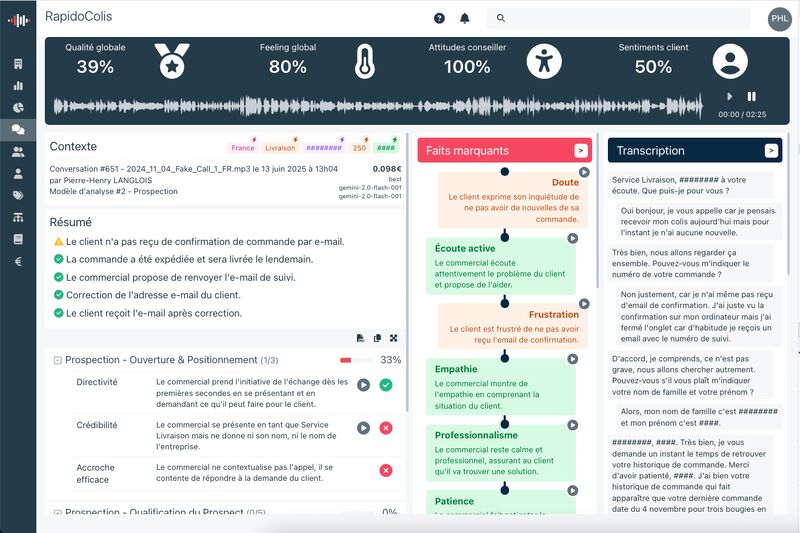
Raisetalk automatically analyzes your exchanges to deliver immediately actionable key performance indicators to teams: KYC validation, detection of recurring objections, identification of complementary products, or effectiveness scoring according to MEDDIC, SPIN, BANT… Result: better-trained sales forces, more satisfied customers, and controlled customer acquisition cost.
1. Understanding Sales Performance: Beyond Simple Revenue
Sales strategy is no longer just about volume of signed contracts. It relies on a range of qualitative and quantitative KPIs:
| Priority KPI | Why it's Crucial | Reference Target |
|---|---|---|
| Conversion Rate (lead → customer) | Measures funnel effectiveness | 15 – 25% in sophisticated B2B |
| Average Transformation Time | Impacts cash-flow and predictability | < 45 days (mid-market SaaS) |
| Retention Rate | Costs 5× less than acquisition | > 85% annually |
| Customer Lifetime Value (CLV) | Indicates profitability by segment | CLV > 3 × CAC |
| Attrition Rate (churn) | Reveals product or service gaps | < 4% monthly in SaaS |
Regular performance audit compares these values to sector benchmarks and feeds the sales dashboard managed by leadership.
2. From Raw Data to Real-Time Sales Dashboard
- Centralize Customer Data
Integrate CRM, marketing automation and call recordings: CRM becomes the single reference. - Industrialize Conversational Collection
AI transcription aligns each conversation with CRM record, adding tags ("cross-sell mentioned", "contractual risk", "price objection"). - Build a Visual Dashboard
Gauges, heat-maps, Slack alerts: every manager instantly sees deviations (conversion rate drop in a segment, explosion of reported defects). - Update Key Performance Indicators:
- conforming delivery rate,
- sales performance by channel,
- evolution of customer acquisition cost.
3. Optimizing the Pipeline: Prospecting, Inbound and Lead Nurturing
3.1 Market Segmentation & Personalization
- Cross market analysis with internal data (CLV, attrition, commercial profitability).
- Build buyer-personas for ultra-targeted digital marketing: each segment receives personalized messages.
3.2 Inbound Marketing and Value Content
- White papers, webinars, sector studies.
- Social selling: consultative selling on LinkedIn combined with sales automation for follow-ups.
3.3 AI-Driven Lead Nurturing
- Predictive scoring: conversion probability, potential value, purchase intent.
- Automatic triggering of a call as soon as a lead downloads key content.
Where are your sales really won or lost?
Upload a few sales calls: objections, buying signals and commitments made come out within minutes.
4. Opportunity Detection via Conversational Analysis
Raisetalk, or any similar engine, listens to 100% of interactions and tags:
| Detected Signal | Proposed Action | Expected Impact |
|---|---|---|
| Complementary product need | Immediate cross-selling | +20% average basket |
| Recurring repurchase intent | Up-selling to premium subscription | CLV × 1.4 |
| Keyword "too expensive" + hesitation | Automatic anti-objection script | Conversion rate +5 pts |
| Dissatisfaction expressed repeatedly | Escalate to Customer Success | Attrition rate –30% |
Every customer remark becomes an acquisition lever or safeguard against revenue loss.
5. Sales Team Management: From Participatory to Excellence
5.1 Variable Compensation Aligned with KPIs
- Base + variable adjusted not only on revenue but also on customer satisfaction.
- Transparent variable compensation policies: fewer internal complaints, strengthened team spirit.
5.2 Participatory Management and Coaching
- Weekly call co-listening sessions (MEDDIC, SPIN method).
- Feedback based on real data, not subjective.
5.3 Continuous Training & Commercial Innovation
- E-learning micro-modules triggered by AI as soon as a criterion is missed (e.g. KYC omission).
- Quarterly certifications: competence becomes an individual performance indicator.
6. Automation & CRM: When Machines Free Humans
- Sales automation: email sequences, calendar reminders, automatic CRM updates.
- API connectors: CRM pushes deals to ERP, support sees customer IDs, compliance retrieves audio recording—all without re-entry.
- API-first commercial partnerships: cross distribution, real-time enriched customer data.
7. Measuring and Reducing Attrition Rate: From Alert to Action
- Automatic monitoring of customer conversations: dissatisfaction expressed, keyword "cancellation".
- Attrition dashboard: at-risk segments, causes (price, defects, competition).
- Retention plan: targeted offer, free repair or replacement, commercial gesture.
- KPI tracking: retention rate rises; customer value increases.
Conclusion: Sales Compliance and Sales Performance Form One Whole
Modern sales performance combines:
- flawless compliance control (automatically recovered via recordings),
- a sales optimization engine (cross-sell, up-sell, fine segmentation),
- sales team management based on objective data,
- a customer culture where satisfaction serves as the main driver.
By placing conversational analysis at the heart of CRM, you eliminate silos: digital marketing, prospecting, risk management, training, all benefit from the same data flow. Every call becomes a strategic asset; every opportunity is leveraged; every non-compliance is eliminated before it costs. The virtuous circle is established: commercial profitability increased, retention rate at its highest, and teams motivated by fair and transparent variable compensation.