
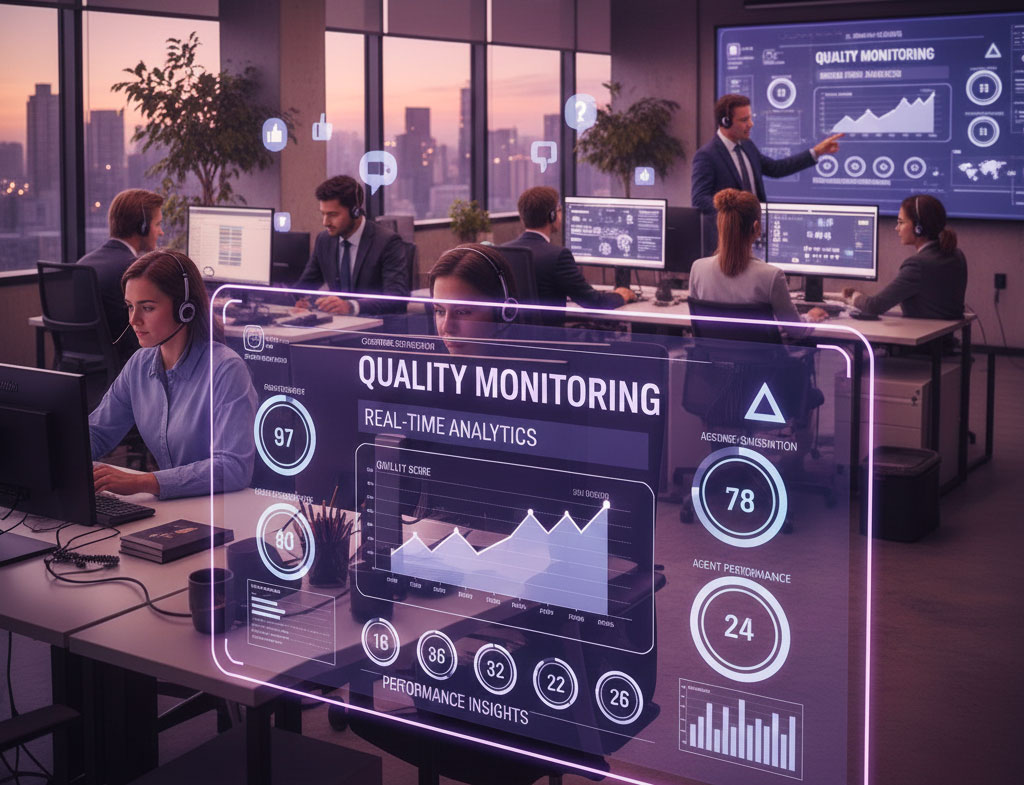
Quality monitoring has become a strategic pillar of customer experience today. In a context where every interaction counts, companies seek to optimize their quality evaluation methods to guarantee customer satisfaction while improving the performance of their customer service agents. But faced with the growing volume of customer interactions, traditional approaches show their limitations.
Quality Monitoring: Much More Than Simple Quality Control
Quality monitoring consists of systematic observation of exchanges between a company and its customers. This practice is no longer limited to passive listening of a few calls: it now encompasses complete analysis of customer interactions across all communication channels, whether telephone conversations, email exchanges, chats, or social media messages.
The objective? Measure the quality of customer relationships, identify recurring pain points, detect the signals customers express, and transform each experience feedback into an improvement opportunity. In this perspective, quality monitoring becomes a true lever for continuous improvement across the entire organization.
The Limitations of Traditional Monitoring Methods
Historically, quality evaluation relied on manual listening of a limited sample of calls by supervisors or dedicated teams. This approach, while rigorous, presents several structural weaknesses. First, it only allows analyzing a tiny fraction of interactions, often less than 2% of total volume. Second, it mobilizes considerable resources and generates delays incompatible with real-time performance improvement requirements.
In a context of increasing outsourcing, where contact centers handle millions of conversations, these monitoring methods quickly show their limits. How can we guarantee exhaustive and objective evaluation when only a handful of exchanges are analyzed? How can we detect emerging trends or weak signals buried in the mass of customer data?
Artificial Intelligence in the Service of Quality Evaluation
Artificial intelligence applied to quality monitoring radically transforms the game. Thanks to voice analysis and speech analytics, it becomes possible to evaluate 100% of customer interactions, in real-time or delayed, across all communication channels. This omnichannel approach guarantees a complete and objective vision of service quality.
AI technologies now allow automatic extraction of essential insights from each conversation: script compliance, objection handling, detection of the signals customers express, identification of recurring pain points, missed commercial opportunities. Monitoring automation frees teams from repetitive tasks to refocus them on strategic analysis and agent training.
KPIs and Dashboards: Measuring to Progress
Effective quality monitoring relies on clearly defined KPIs and customizable dashboards that offer immediate visibility on agent performance and customer satisfaction. Traditional indicators such as first contact resolution rate, average handling time, or Net Promoter Score remain essential, but can now be enriched with finer metrics.
How the signals expressed by the customer evolve throughout the interaction, conversion rate after a commercial exchange, quality of active listening practiced by agents, or compliance with procedures: all indicators that enable granular understanding of quality interactions. These dashboards become true strategic evaluation tools, enabling rapid identification of priority improvement areas.
From Feedback to Coaching: Transforming Evaluation into Performance
Quality monitoring is only valuable if it leads to concrete improvement. This is why customer feedback and experience feedback must be systematically leveraged to fuel agent training. Post-interaction feedback, whether from automated evaluation or managerial analysis, must be shared quickly with field teams.
Continuous agent training relies on these insights to develop specific skills necessary for each context: handling complex complaints, sales techniques, tool mastery, soft skills. This permanent improvement loop, fed by systematic observation of all interactions, gradually raises the overall quality level.
The Hybrid Approach: Human and Machine in Service of Excellence
While artificial intelligence revolutionizes quality monitoring, it doesn't replace human expertise—it multiplies it. The optimal approach combines AI's exhaustiveness and objectivity with the contextual judgment and empathy of quality teams. AI identifies patterns, detects anomalies, and signals critical interactions, while managers focus on in-depth analysis, personalized coaching, and strategic decisions.
This hybrid approach guarantees the best of both worlds: 100% coverage thanks to monitoring automation, and depth of analysis preserved through targeted human intervention on situations with higher added value.
Toward Predictive Quality Monitoring
Modern evaluation tools no longer just analyze the past—they anticipate the future. By cross-referencing customer data with identified behavioral patterns, AI can predict churn risks, detect customer experience degradation signals before they become critical, or identify commercial opportunities with high conversion potential.
This predictive dimension of quality monitoring transforms the quality function from a post-facto control role into a true strategic partner for growth. The insights generated feed not only immediate operational improvement but also strategic decisions on service evolution, training, or customer service organization.
Conclusion: Quality Monitoring as Competitive Advantage
In an environment where customer experience becomes the main differentiation factor, quality monitoring evolves from a compliance constraint to a true performance lever. Organizations that know how to intelligently leverage their customer interactions, combining artificial intelligence and business expertise, will have a decisive competitive advantage.
The quality monitoring of the future enables transforming every conversation into actionable insight, every pain point into an improvement opportunity, and every customer feedback into a growth lever. This is the vision we champion at Raisetalk: making your millions of interactions a strategic asset in service of operational excellence.


