
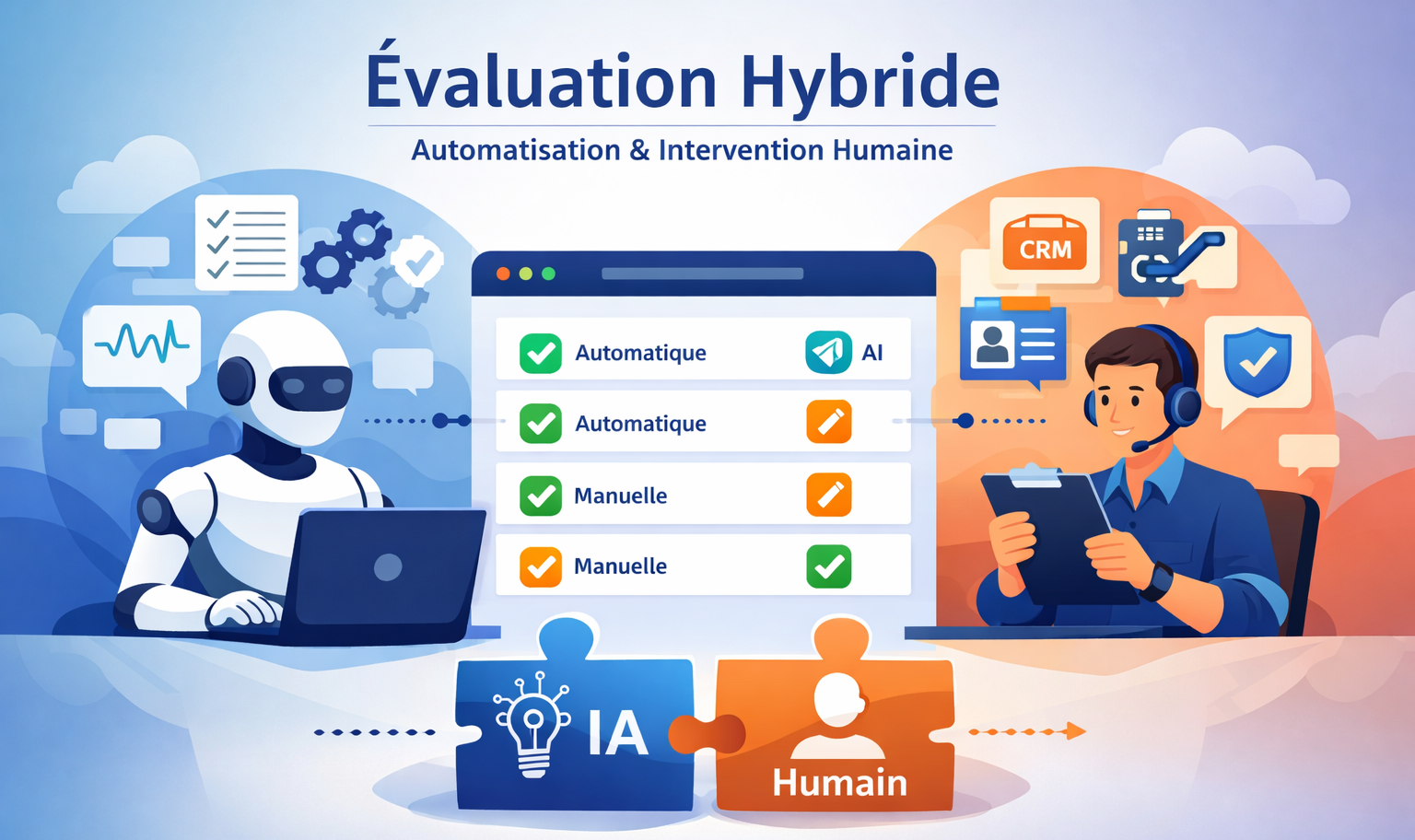
Hybrid analysis: combine automatic and manual evaluation in Raisetalk

Conversational analysis platforms allow you to automatically evaluate hundreds of criteria on each interaction. But some elements remain impossible to detect automatically, because they simply are not in the conversation.

Hybrid analysis, automated and manual, in Raisetalk

The challenge: not everything can be automated

Conversational analysis platforms like Raisetalk allow you to automatically evaluate hundreds of criteria on each interaction: greeting quality, empathy, reformulation of customer needs, commercial proposal...

But some elements remain impossible to detect automatically, because they simply are not in the conversation, particularly for compliance with your internal processes:

  • did the agent properly create the ticket in your CRM?
  • Did they follow the planned escalation procedure?
  • Did they validate the customer's identity according to your security protocol?

These verifications require the intervention of a supervisor who accesses your business tools.

Until now, this meant managing two evaluation systems in parallel, with all the risks of inconsistency and time waste that this entails.

The solution: hybrid analysis

Raisetalk now offers to combine automatic and manual evaluation within the same analysis grid.

For each criterion in your grid, you simply define the desired evaluation mode: automatic (by AI) or manual (by a supervisor).

➔ This approach offers total flexibility: you maintain the efficiency of automation for criteria detectable in the conversation, while integrating human expertise where it is essential.

How does it work?

Simple configuration

When creating or modifying a criterion in your evaluation grid, select "Manual" in the evaluation field.

➔ Other parameters (title, weighting, rating scale) are configured as usual.

Collaborative evaluation

Supervisors complete manual criteria directly in the Raisetalk interface.

➔ This evaluation can be done in multiple sessions, allowing different managers to be involved if necessary.

Mandatory justification

As with automatic evaluations, each manual rating comes with a comment.

➔ The agent thus receives complete and constructive feedback to improve.

Modification history

Each version of the analysis is preserved and accessible, ensuring total traceability of evaluations.

Tracking incomplete analyses

Easily identify conversations where some criteria remain to be evaluated by filtering on the "N/A" rating.

Concrete benefits

This feature addresses a need expressed by many quality managers: having a unified view of performance, without multiplying tools and exports.

Your teams gain efficiency by centralizing all evaluations in one place.

Your agents benefit from consistent and complete feedback.

And you maintain a global view of quality, whether it concerns conversational criteria or compliance with your business processes.

Thousands of small blue tiles, of which only about thirty are lit up in coral
Quality Monitoring 14 min

Analysing 100% of calls: what the statistics say, and what it really costs

With 30 calls listened to a month, an 80% compliance rate in fact lies anywhere between 63% and 91%, and a ten-point drop cannot be told apart from chance. The calculation vendors do not show, the gap from which an action plan is justified, what analysing every call really changes, what it does not solve, and its cost per evaluated conversation.

Six rounded steps climb towards a large grid of tiles fully lit up in coral
Quality Monitoring 12 min

Moving to 100% quality monitoring: the six-step method

Moving from sample-based listening to analysing every call changes the method, not just the tool. Deciding what you measure, rewriting the scorecard, calibrating the analysis against your evaluators, prioritising alerts, budgeting by the minute and redeploying the quality team: the six steps, with the calibration protocol and the mistakes to avoid.

A coral thread starts from a checklist of ticked boxes and draws a heart
Quality Monitoring 17 min

Quality Monitoring: are you more "procedural" or "relational"?

A procedural scorecard checks that the advisor introduced themselves, rephrased and closed the call. A relational approach looks at what the call produced for the customer: a problem solved, a commitment kept, a reason to trust. What research says, our stance inspired by the Agile Manifesto, how to measure the relationship without measuring emotion, and a test to place your own set-up.

A coral umbrella shelters a file labelled ACPR, with a form, an advice form and a call's sound wave coming out of it
Strategy 17 min

Insurance in France: what a defensible duty-to-advise file looks like in an ACPR inspection

For insurers, brokers and agents selling insurance in France, particularly by telephone. Since recommendation 2024-R-03, the duty to advise must be proven in writing for all insurance products, and in May 2026 the ACPR ruled that an oral exchange is not enough. Yet it is listening to the calls that brings advice forms down. The four documents of a defensible file, the consistency test between the written record and the call, and what an analysis tool does, or does not do, for you.

A field of blue dots from which a short coral line stands out, rising
Voice of Customer 13 min

Weak signals in customer conversations: spotting them without inventing intentions

A weak signal is a rare, recurring and growing fact, not a dissatisfied customer. Four forms can be spotted reliably in calls: a phrase that keeps coming back, the same reason for a repeat call, a reworded request, a break in the expected flow. The four-step method to detect them across every call, the false signals to rule out, and why an emotion score is not one.

Twelve identical cards sorted into four groups, one of them entirely coral
Conversational Analysis 16 min

12 conversational analysis software tools in 2026: the comparison for French-speaking contact centres, without ranking

Gong, Fireflies.ai, CallMiner, Observe.AI, Genesys Cloud, Verint, Raisetalk: under the "conversational analysis" label, four families of tools that do not listen to the same thing. Twelve software tools reviewed with the criteria of a French-speaking contact centre: public pricing, documented French support, data hosting, auditability of scores. No rating and no podium, with sources, and with the cases where Raisetalk is not the right choice.

Upload a call. Read its analysis. Five minutes.

Sign up in seconds, with no credit card and no cookies. A welcome tour walks you through the key principles, then you add your first conversation.

Early access · Your feedback shapes the product