
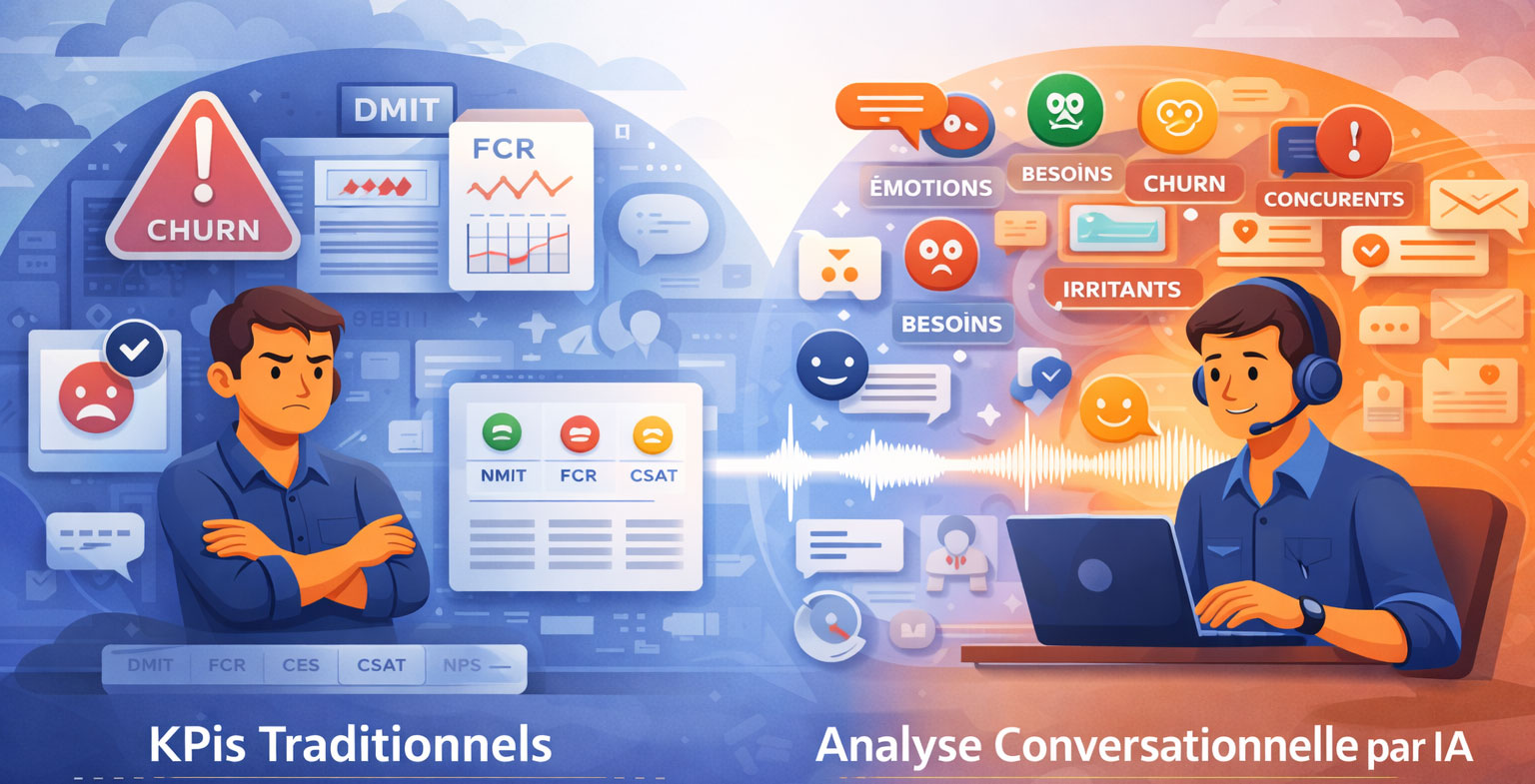
Key takeaways on customer relationship KPIs
- Traditional technical KPIs (wait time, answer rate, average handle time) measure operational efficiency, not customer satisfaction
- Satisfaction surveys (CSAT, NPS, CES) suffer from low response rates (5 to 30%) and only capture a point-in-time impression
- AI conversational analysis now enables extracting insights from 100% of interactions: expressed signals, complaints, contact reasons, churn signals
- The satisfaction customers actually express is hidden in the conversations themselves, not in time metrics or post-call surveys
- Raisetalk transforms every conversation into a source of actionable business intelligence in real-time
Why traditional KPIs are no longer enough?
For years, contact centers have optimized their operations around technical metrics: how long before answering, how long to handle a call, how many calls resolved at first contact. These indicators are useful for managing team productivity, but they say nothing about what really matters: the satisfaction customers express.
A call can be handled in 3 minutes (excellent AHT), answered in 30 seconds (perfect answer rate), and still leave the customer deeply dissatisfied because they didn't get an answer to their question or weren't really listened to.
The technical indicator trap: A short handle time doesn't mean quality resolution. A customer may hang up quickly because they gave up, not because they're satisfied.
What are the main technical KPIs of customer relations?
Here are the most commonly tracked indicators by customer service departments:
| KPI | What it measures | Formula | Limitation |
|---|---|---|---|
| Answer Time | Delay before an agent answers | Average wait time | Says nothing about the quality of the exchange |
| Average Handle Time (AHT) | Time spent on a complete interaction | Total time / Number of calls | Risk of prioritizing speed over quality |
| First Contact Resolution (FCR) | Proportion of problems resolved at first contact | Resolved tickets / Total tickets | Difficult to measure objectively |
| Recontact Rate | Customers who call back for the same problem | Recontacts / Total contacts | Doesn't specify the cause of recontact |
| Overall Resolution Rate | Proportion of closed tickets | Resolved tickets / Total tickets | Doesn't measure the quality of resolution |
| Cost per Contact | Average cost of an interaction | Monthly costs / Interactions | Complex to calculate, favors cost reduction at the expense of quality |
The finding: These metrics are all process-oriented, not customer-oriented. They answer the question "Are we efficient?" but not the question "Are our customers satisfied?".
How is customer satisfaction traditionally measured?
Faced with the limitations of technical KPIs, companies have developed satisfaction surveys to directly ask customers:
The 3 main satisfaction surveys
| Survey | What it measures | Typical question | Limitation |
|---|---|---|---|
| CSAT (Customer Satisfaction Score) | Immediate post-interaction satisfaction | "Are you satisfied with this exchange?" (1-5) | Point-in-time impression, without context |
| NPS (Net Promoter Score) | Propensity to recommend the company | "Would you recommend our service?" (0-10) | Doesn't say why customers recommend (or not) |
| CES (Customer Effort Score) | Effort perceived by customer to solve their problem | "How much effort did you have to make?" (1-5) | Subjective, varies according to expectations |
The major problem: very low response rates
The satisfaction survey challenge:
- Average response rate: only 5 to 30%
- Dissatisfied customers respond more than satisfied customers (negative bias)
- Closed questions don't capture the why of dissatisfaction
- Customers are tired of receiving questionnaires after each interaction
Result: You're managing your customer service based on a non-representative sample of your interactions, without understanding the true reasons for satisfaction or dissatisfaction. Gathering the voice of the customer without a survey is possible by relying directly on the content of calls, bias included.
What can really be measured in a customer conversation?
Here's what's hidden in your conversations that technical KPIs can't capture:
The invisible insights in traditional metrics
- Signals expressed by the customer: dissatisfaction, complaints, thanks, expressed satisfaction, identified in the words used and the behaviors observed during the exchange
- The contact reason: why the customer is really calling (not just the ticket category, but the underlying need)
- Recurring pain points: friction points that come back in several conversations and that no survey captures
- Churn signals: mentions of competitors, cancellation threats, expressed dissatisfaction
- Quality of resolution: did the customer really get what they were looking for, or did they hang up and drop their request?
- Business opportunities: expressed needs, interest in other products, moments of expressed satisfaction conducive to upselling
- Process compliance: legal conformity, script followed, mandatory mentions stated
These pieces of information are already in your recordings. But without automated analysis, they remain unexploited because it's impossible to listen to and manually analyze 100% of calls.
How does AI transform the measurement of customer satisfaction?
AI conversational analysis radically changes the game: instead of measuring indirect indicators (time, rates) or soliciting customer samples (surveys), it analyzes 100% of your conversations to extract the most valuable insights.
What Raisetalk automatically detects in every conversation
| Insight | Description | Use case |
|---|---|---|
| Customer signals | Positive, negative or neutral signals expressed by the customer throughout the exchange | Identify moments of dissatisfaction or expressed satisfaction |
| Themes and topics | Automatic categorization of contact reasons | Understand the real topics that concern your customers |
| Churn signals | Mentions of cancellation, competitors, lasting dissatisfaction | Alert teams to intervene before it's too late |
| Sales compliance | Verification of script compliance, legal mentions, commitments | Prevent disputes and ensure regulatory compliance |
| Handling quality | Effective resolution, agent empathy, process compliance | Improve team coaching |
| Recurring pain points | Friction points that come back in several conversations | Prioritize product or process improvement projects |
| Business opportunities | Expressed needs, mentioned projects, moments conducive to upselling | Transform customer service into a growth lever |
With Raisetalk, every conversation becomes a source of business intelligence. You no longer depend on samples or questionnaires: you leverage 100% of your interactions to manage your customer relationship.
Why analyzing 100% of conversations changes everything?
The difference between analyzing 5 to 30% of customers (via satisfaction surveys) and 100% of conversations (via AI) isn't just a matter of volume. It's a change in the nature of understanding your customers.
Comparison: traditional approach vs. AI approach
| Criterion | Satisfaction surveys (CSAT, NPS, CES) | AI conversational analysis |
|---|---|---|
| Coverage | 5 to 30% of customers | 100% of interactions |
| Solicitation rate | Survey fatigue | No customer solicitation |
| Analysis depth | Closed questions, little context | Complete analysis of context, expressed signals, themes |
| Speed of exploitation | Delayed results (post-questionnaire) | Real-time insights |
| Objectivity | Response bias (dissatisfied overrepresented) | Exhaustive and neutral analysis |
| Weak signal detection | Impossible (sample too small) | Automatic detection of churn signals, recurring pain points, opportunities |
| Compliance and quality | Not measurable | Automatic verification on 100% of exchanges |
Warning: Technical KPIs (AHT, FCR, answer rate) remain useful for managing operational efficiency. Conversational analysis doesn't replace them, it complements them by adding the missing qualitative dimension.
Which KPIs should you track in 2026?
Here's our recommendation for balanced management of your customer relationship:
Operational KPIs (to keep)
| KPI | Why keep it | Monitoring frequency |
|---|---|---|
| Average Handle Time (AHT) | Manage team productivity | Weekly |
| Answer rate | Detect activity peaks and adjust staffing | Daily |
| Contact volume | Anticipate resource needs | Daily |
| Cost per contact | Control customer service budget | Monthly |
New KPIs from conversational analysis
| KPI | What it measures | Business impact |
|---|---|---|
| At-risk conversation rate | Proportion of conversations with detected churn signals | Prevent attrition |
| Expressed satisfaction score | Share of positive signals expressed by customers on 100% of conversations | Measure the satisfaction expressed across all conversations (not a biased sample) |
| Effective resolution rate | Proportion of conversations where the customer really got what they were looking for | Improve service quality |
| Top 10 customer pain points | Recurring topics generating complaints | Prioritize improvement projects |
| Script compliance rate | Proportion of conversations where the script was followed | Reduce legal risks |
| Number of business opportunities detected | Needs expressed by customers not exploited | Transform customer service into a growth lever |
Our recommendation: Combine operational KPIs (efficiency) and conversational KPIs (quality and satisfaction). The former manage your resources, the latter manage your customer experience.
How does Raisetalk reveal the true voice of your customers?
Raisetalk automatically analyzes your phone conversations to extract the essentials:
Key features
- Multilingual transcription: support for all languages, with 7 Speech-to-Text models to choose from
- Detection of expressed signals: automatic identification of the satisfaction or dissatisfaction expressed by the customer (complaints, thanks, repeated requests) throughout the exchange
- Theme extraction: automatic categorization of contact reasons, objections, requests
- Smart alerts: real-time notifications about at-risk conversations (churn, strong expressed dissatisfaction, non-compliance)
- Quality Monitoring: automatic evaluation on 100% of calls (vs. 1 to 5% in manual listening)
- Sales compliance: automatic verification of script compliance, legal mentions, commitments
- GDPR pseudonymization: automatic replacement of personal data to protect privacy
Concrete benefits
- -70% quality evaluation time: automation of analysis, freeing time for coaching
- +98% evaluation coverage: analysis of 100% of conversations vs. 1 to 5% manually
- -85% bias in evaluation: standardized and objective scoring
- Real-time detection of at-risk conversations: intervention before it's too late
Raisetalk transforms your customer relationship: you no longer manage on technical indicators or biased samples, but on real intelligence extracted from 100% of your conversations.
What are the limitations of AI conversational analysis?
Like any technology, conversational analysis has its limitations:
| Limitation | Explanation | Raisetalk solution |
|---|---|---|
| Audio quality dependency | Poor recording produces imperfect transcription | 7 STT models available to adapt to all use cases |
| Multilingual conversations | Need to detect and transcribe multiple languages in the same exchange | Native multilingual support with automatic translation |
| Off-conversation elements | AI cannot analyze what is not said (external context, customer history, etc.) | Hybrid analysis: combine automatic and manual evaluation |
| Contextual interpretation | Some statements require business context to be correctly interpreted | Customization of analysis criteria according to your business |
AI analysis doesn't replace humans: it augments team capabilities by processing volume (100% of calls), while managers focus on coaching and complex cases.
How to get started with conversational analysis?
Moving from an approach based on technical KPIs and satisfaction surveys to an approach driven by conversational analysis requires a few steps:
1. Audit your current KPIs
- What indicators are you tracking today?
- Which ones really measure customer satisfaction (vs. operational efficiency)?
- What's your satisfaction survey response rate?
2. Identify your priority use cases
- Quality Monitoring: improve service quality and coaching
- Sales compliance: verify script compliance and legal obligations
- Voice of Customer: detect pain points, needs, churn signals
- Business opportunities: transform customer service into a growth lever
3. Test on a sample
Raisetalk offers a free trial space to test conversational analysis on your own recordings: https://app.raisetalk.com/try
4. Deploy progressively
Start by analyzing 100% of conversations from one team or a specific use case, then expand based on results.
Need support to transform your KPIs?
Our team can help you:
- Audit your current indicators
- Identify actionable insights in your conversations
- Configure alerts and dashboards tailored to your challenges
- Train your teams to leverage conversational analysis
Contact us to discuss your project: https://www.raisetalk.com/contact
AI conversational analysis is not a technological gadget: it's a paradigm shift in how you understand and manage your customer relationship. Where traditional KPIs measured efficiency, AI now captures the satisfaction your customers express, across 100% of their conversations.


