
Scores and scoring
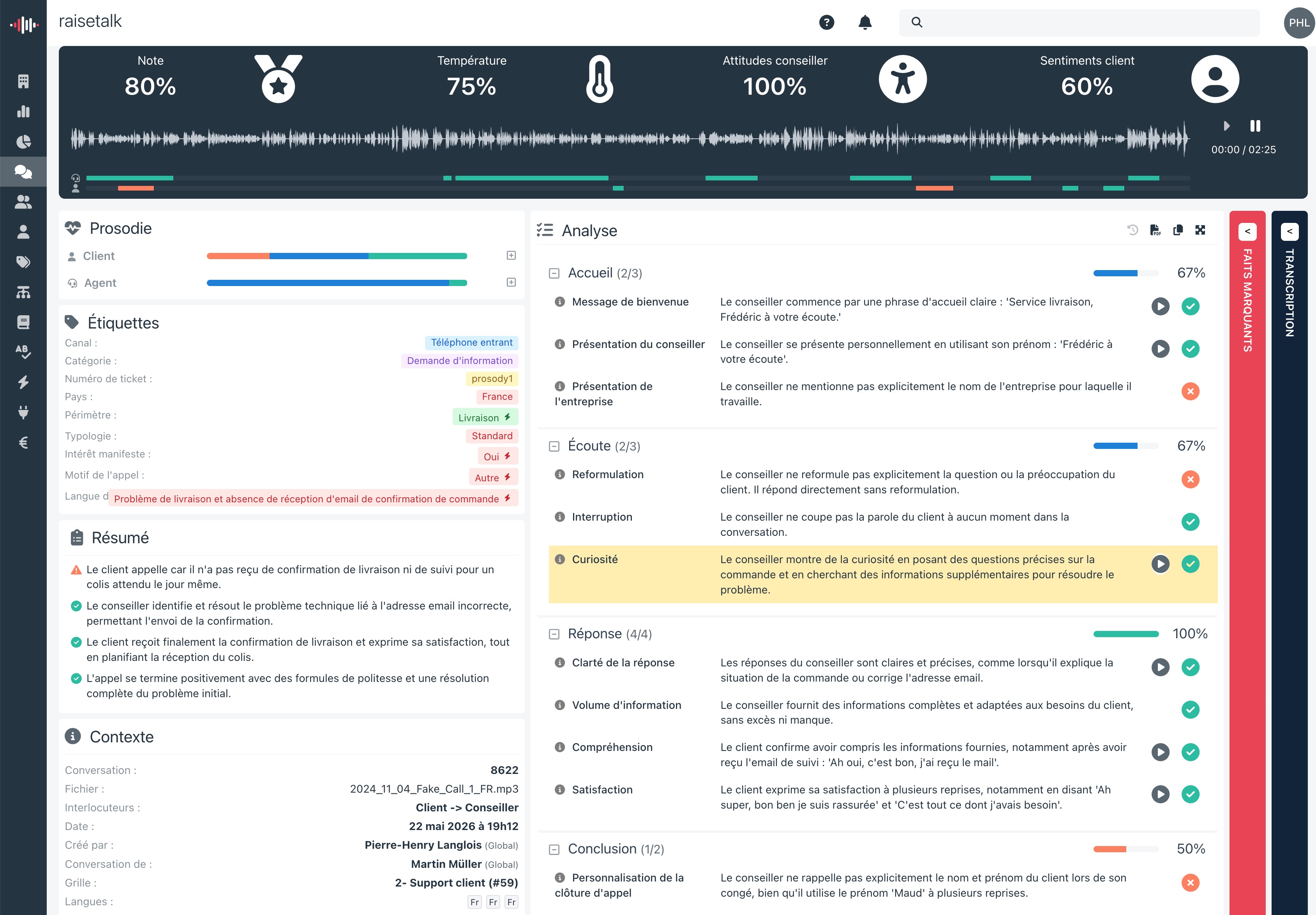
The score is the central indicator of a conversation analysed by Raisetalk: it summarises, as a percentage, the quality measured by your criteria grid. Understanding how it is calculated helps you interpret reports and answer the question teams ask most often: "why is this conversation scored this way?"
This article assumes you are already familiar with weighting criteria in points. If not, start with Effective criteria, which explains how each criterion receives its weight.
The principle: points earned over maximum points
Criteria are grouped by category. Each group of criteria receives its own score, and the conversation receives an overall score. All these scores rely on a single formula:
Score = sum of points earned / sum of maximum points, expressed as a percentage.
- Points earned: the points actually awarded to the conversation for each criterion. An achieved criterion earns its points (positive); a not-achieved criterion removes points (negative); a criterion with no impact adds nothing.
- Maximum points: the total points the conversation would have earned if each of the criteria taken into account had been achieved.
A score of 80% therefore means the conversation earned 80% of the points it could have reached on the criteria that applied to it.
Two rules complete this principle, detailed below: non-applicable criteria are excluded from the calculation, and the score never drops below 0%.
Non-applicable criteria are excluded
Not every criterion in a grid applies to every conversation. A criterion can be non-applicable (marked NA) in two main cases:
- it is a conditional criterion whose condition is not met (for example "if the customer is put on hold, the agent warns them" on a conversation with no hold);
- the AI does not have the elements needed to make a judgement.
A non-applicable criterion is removed from the calculation, both from the numerator and the denominator. In other words, it neither penalises nor inflates the score: it is as if the criterion did not exist for that conversation. This is what guarantees a conversation is never penalised on a criterion that did not concern it.
Consequence: if a group contains only NA criteria, its score is itself NA: there is nothing to calculate.
The score never drops below 0%
A not-achieved criterion removes points. On a conversation that accumulates negative signals, the sum of points earned can become negative, and the calculation would then give a negative percentage.
In this case Raisetalk brings the score back to 0%. A group score, like the overall score, is always between 0% and 100%: negative points pull the score down, but it stops at zero.
The overall score is not the average of the groups
An important point for reading a report correctly: the overall score is not the average of the group scores. It is recalculated directly from all the criteria of the conversation, with the same formula.
Concretely, the points earned of all applicable criteria are added up, across all groups, then divided by the sum of their maximum points. The group scores only provide a detailed reading by theme; they do not, as such, enter into the calculation of the overall score.
This distinction explains some situations that are surprising at first glance: a group can show 0% (or NA) without mechanically bringing the overall score down to that value, because the overall score always starts again from the raw points. The examples below illustrate this.
Worked examples
The following examples start from a simple grid and add, at each step, a slightly trickier case. In every table, points earned can be negative (not-achieved criterion), and maximum points represents the criterion's ceiling if it is achieved.
Simple example
A conversation evaluated on a single group of three criteria:
| Criterion | Points earned | Maximum points |
|---|---|---|
| Greeting | 10 | 10 |
| Rephrasing | 10 | 10 |
| Script compliance | -10 | 10 |
| Total | 10 | 30 |
Group score = 10 / 30 = 33.33%. As there is only one group, the overall score is identical: 33.33%.
Example with a non-applicable criterion
We add a second group, containing a single criterion that is non-applicable to this conversation:
| Group | Criterion | Points earned | Maximum points |
|---|---|---|---|
| 1 | Greeting | 10 | 10 |
| 1 | Rephrasing | 10 | 10 |
| 1 | Script compliance | -10 | 10 |
| 2 | Hold management | NA | NA |
- Group 1: 10 / 30 = 33.33%
- Group 2: contains only an NA criterion, its score is NA
- Overall score: the NA criterion is excluded, we find 10 / 30 = 33.33% again
The non-applicable criterion has no effect on the overall score.
Example with negative points (floor at 0%)
We add a third group, heavily penalised:
| Group | Criterion | Points earned | Maximum points |
|---|---|---|---|
| 1 | (3 criteria, see above) | 10 | 30 |
| 2 | Hold management | NA | NA |
| 3 | Commitment not kept | -30 | 10 |
- Group 3: -30 / 10 = -300%, brought back to 0%
- Overall score: we start again from the raw points, i.e. (10 - 30) / (30 + 10) = -20 / 40 = -50%, brought back to 0%
Here, group 2 (NA) stays out of the calculation, the negative group 3 pulls the score down, and the floor at 0% applies to both the group score and the overall score.
Edge case: a group with no maximum points
A last, rarer case: a group whose only criterion earns no points if it is achieved (maximum of 0 points), but removes points if it is not achieved.
| Group | Criterion | Points earned | Maximum points |
|---|---|---|---|
| 1 | (3 criteria, see above) | 10 | 30 |
| 2 | Hold management | NA | NA |
| 3 | Mandatory disclosure missing | -10 | 0 |
- Group 3: -10 / 0, the division is impossible, its score is NA (there is no maximum to base it on)
- Overall score: the criterion's points still count, i.e. (10 - 10) / (30 + 0) = 0 / 30 = 0%
This case illustrates one last time the difference between group score and overall score: group 3 shows NA, for lack of a maximum, but its negative criterion does weigh in the overall score, which falls to 0%.
In summary
- The score equals points earned / maximum points, as a percentage, for a group as for the whole conversation.
- Non-applicable (NA) criteria are excluded from the calculation: they never penalise a conversation.
- The score is always between 0% and 100%: negative points cannot make it drop below zero.
- The overall score is recalculated from all the criteria, it is not the average of the group scores.