
The essentials on tracking advisor coaching
- Evaluating is not coaching. A score helps no one improve until a manager has talked it through with the advisor. The debrief is that moment, and it is the debrief that needs tracking.
- The number of debriefs is not enough. It says neither whether they were completed, nor which advisors were seen, nor which calls they covered.
- A debrief is tracked by stage: who has to act now, the manager or the advisor, and since when. That is what separates a debrief in progress from a forgotten one.
- Coverage matters as much as volume: the share of advisors debriefed over the period, and the time since each advisor's last debrief.
- A score that rises after a debrief does not prove its effect. The effect is read with caution, on the criteria worked on, before and after.
- The Raisetalk Debriefs report brings these readings together: the time taken at each stage, open and blocked debriefs, coverage by team, points worked on and themes covered.
Evaluating is not coaching
An evaluation says what happened in a call. It changes nothing in the next call until it has been discussed. That is the role of the debrief: a manager opens an exchange on an evaluation, writes down what they take from it, the advisor replies, and the exchange is closed. We described this moment in our article on the evaluation debrief.
With every conversation analysed, material is no longer in short supply: each advisor has dozens of evaluations, each one backed by passages of the call. The time the quality team used to spend listening can go to coaching. It remains to be seen whether that time really goes there. The question a head of customer service asks is simple: is coaching taking place, for every advisor, and what does it change?
Few organisations can answer. Debriefs are held in diaries, spreadsheets or corridor conversations, and what gets counted says very little.
Why the usual measures mislead
| Measure | What it suggests | What it lacks |
|---|---|---|
| The number of debriefs per manager | "This manager coaches a lot" | Their outcome: a debrief opened and never closed counts as a debrief, and one advisor can account for half of them |
| The average duration of a debrief | "Our debriefs take twelve days" | The spread: a few forgotten debriefs pull the average up, whereas most are settled within the day |
| The score after the debrief | "The debrief helped the advisor improve" | The comparison: a weak call is followed by better calls, with or without a debrief |
The third is the most appealing, and the most fragile. Take an assumption: an advisor whose average score is 78 out of 100. Their manager debriefs a call scored 55, chosen because it was weak. The following calls hover around 78, as before. The score "rises" by more than twenty points after the debrief, without the debrief having anything to do with it: the calls simply return towards the advisor's average. The more you debrief weak calls, the more marked this effect is.
The method: five rules for tracking coaching
1. Track stages, not a total
A debrief goes through stages: the manager's comment, the advisor's reply, the closing. At any moment, an open debrief is waiting for someone. Knowing who, and since when, changes the reading: ten debriefs awaiting the manager and ten awaiting the advisor do not call for the same action.
Set an overdue threshold too, seven days for example. Beyond it, a debrief is no longer in progress, it is stalled, and it must be either resumed or abandoned. A debrief left open holds the advisor up: until it is closed, the discussion of their evaluation remains unresolved.
2. Measure times as a median, stage by stage
The total time hides what matters. Measure each stage: from opening to the manager's comment, from that comment to the advisor's reply, from the reply to closing. And take the median: out of ten debriefs, if nine are settled in one day and a single one drags on for 41 days, the average shows 5 days and the median one day. The median describes how things normally run; the forgotten debrief is dealt with separately, in the list of open debriefs.
Very short times also mean something. Two comments entered within the hour often signal a debrief held face to face, in a meeting, where the tool serves as the record.
3. Look at coverage: who has not been seen
The volume of debriefs can rise while half the team is never debriefed. Two measures show it:
- the share of advisors debriefed at least once over the period, among those with evaluated conversations;
- the time since each advisor's last debrief: under 30 days, 30 to 60, 60 to 90, over 90, or never.
An advisor with no debrief for more than two months is an action for their manager, not a finding about the advisor. And an advisor who is debriefed often is not necessarily struggling: they may be new, or working on an activity that is changing.
4. Know which calls you debrief
Compare the score of debriefed conversations with that of all evaluated conversations. If debriefs cover almost nothing but weak calls, coaching serves only to correct. Successful calls have their place: an advisor also improves by hearing again what they do well.
Look at the age of the calls too. A debrief on a three-week-old conversation is about an exchange the advisor has forgotten.
5. Note what was worked on, and reread it later
A useful debrief covers one, two or three specific points. Note them at closing, as the scorecard criteria concerned. A month later, look at the share of the advisor's conversations where these criteria are acquired, before and after the debrief, leaving the debriefed call aside. The comparison remains indicative, for the reason given above, but it bears on what was worked on, not on an overall score, and it gives the manager a subject for the next debrief.
The Debriefs report: the method applied in Raisetalk
In Raisetalk, the debrief is held on the evaluation page, with the score, the criteria and the passages of the call in view. The Debriefs report gives the overall view. It opens from the Understand page, like the other analytical reports, and reads better over three months than over one: a debrief runs over several days, and its times are compared over several weeks.

Video, 2 minutes: from open debriefs to the advisors to see again.
Eight indicators, read as a flow
The first row follows debriefs as a flow: those that were opened, the advisors debriefed ("7 of 9"), those still open at the end of the period, with one bar per stage, and those that were closed. The second gives four median times: the manager's input, the advisor's input, the closing, and the total time from opening to closing.

No colour qualifies the volumes: a number of debriefs is neither good nor bad in itself. Only coverage, times and open debriefs read in one direction.
Where the time goes
The Course of a debrief timeline places each stage at its median, in days since opening, with a line running to the time that nine debriefs out of ten do not exceed. The conversation appears before the opening: you can see whether recent calls are being debriefed. Times are also broken down into bands, from under an hour to over thirty days, which separates lateness from neglect.

Open debriefs, and those that are blocked
Open debriefs are sorted by stage and by age: Awaiting manager, Awaiting advisor, To close. The five oldest are shown with the advisor, the person who opened the debrief and the stage. A badge flags a blocked debrief, when the advisor is no longer active or the evaluation has been disabled: it can no longer be closed, and all that remains is to abandon it. This is the list to pick up first.

Advisor coverage
Two tiles answer the question "who has not been seen?": the number of advisors debriefed over the period and their breakdown (no debrief, one, two to three, four or more), then, team by team, the time since each advisor's last debrief. A link opens the list of advisors with no debrief for more than 60 days.

The report's table reads by team, by manager or by advisor. The Advisor view is not a ranking: it is sorted by team and then by name, with no colour of judgement, and managers are shown without a league table. Debriefing is an act of management, not a sanction.
What debriefs change
- Debriefed conversations: their score compared with that of all evaluated conversations, and their context (an alert, a dispute, a call more than 14 days old).
- Adjustments: the criteria a manager adjusted during a debrief, by direction and by criterion. A criterion that is often adjusted leads to the Disputes report, which says whether it should be rewritten.
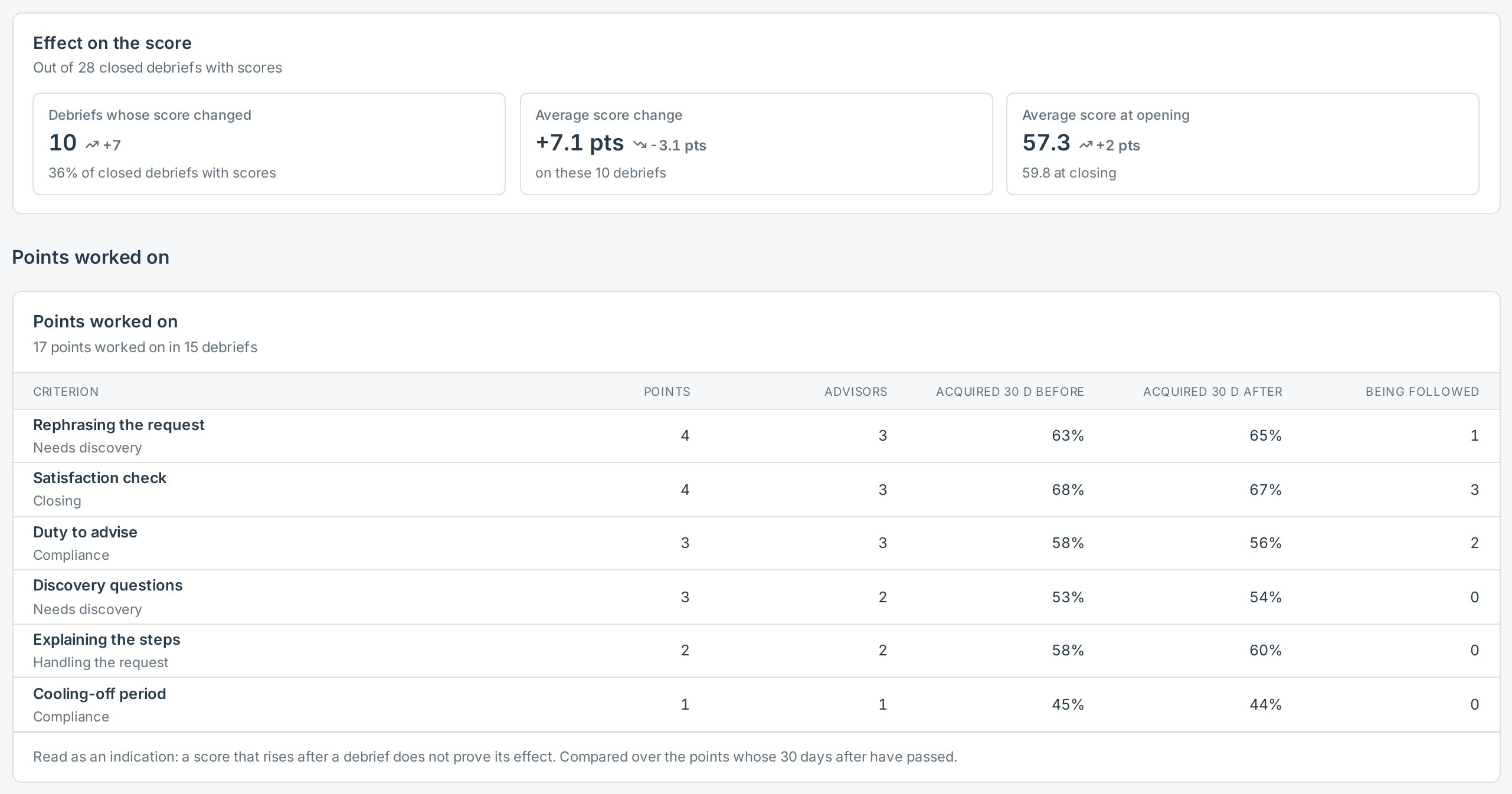
- The effect on the score: the score recorded at opening and at closing, for the debriefs where it changed.
- Points worked on: the manager notes one to three criteria per debrief, and the report tracks the share of conversations where each is acquired, 30 days before and 30 days after.
- Themes worked on: the subjects of managers' comments and the positions stated by advisors (agreement with the finding, context clarified, request for support), counted across the whole scope, with no name or quotation.
A click on an advisor opens their panel: their debriefs of the period, the times, the points worked on and their score over six months, with a mark at each debrief. Comment excerpts stay on screen: neither the PDF, nor scheduled sends, nor the report summary contain any, and the summary never receives a person's name.
Like the other reports, it can be compared, shared, exported as a PDF and scheduled (see scheduled reports). Sent every Monday to managers, it reminds them of their open debriefs and of those that have been waiting for more than 7 days.
Where to start
- Pick up the debriefs that have been open for more than 7 days. Finish those that can be finished, abandon those that are blocked.
- Find the stage that is waiting. If debriefs are awaiting the manager, the issue is the manager's time. If they are awaiting the advisor, check that the advisor has been notified and knows how to reply.
- Open the list of advisors with no debrief for more than 60 days. Each manager will find their next debriefs there.
- Debrief successful calls too. If the score of debriefed conversations is well below the average, vary the choice of calls.
- Note one to three points worked on at each debrief. In a month, you will know which criteria your debriefs cover, and what becomes of those criteria.
Set a rhythm, not a quota. "Every advisor debriefed at least once a month" is tracked on coverage and the time since the last debrief. "Ten debriefs per manager" is tracked on a total, and can be reached by debriefing the same advisors ten times. The first target serves the team, the second fills in a table.
What tracking does not tell you
An honest measure also states its limits.
- A score that rises after a debrief does not prove its effect. The calls that follow a weak call rise by themselves towards the advisor's average. The report shows the score before and after without inferring an effect.
- The times of a recent period are provisional. Only the quick debriefs are already closed. The number of debriefs still open is always shown next to a median.
- The report sees only the debriefs opened in the tool. An exchange held without an open debrief does not appear. Opening the debrief, even for a ten-minute conversation, keeps a record of it.
- It does not judge the quality of an exchange. It says whether the debrief took place, how long it took and what it covered. What was said is read in the comments, on the evaluation page.
Key terms
- Debrief: exchange opened by a manager on an evaluation, from its start to its closing or abandonment
- Stage of a debrief: what the debrief is waiting for, the manager's comment, the advisor's reply or the closing
- Overdue debrief: debrief open for more than 7 days
- Blocked debrief: debrief that can no longer be closed, because the advisor is no longer active or the evaluation has been disabled
- Coverage: share of advisors debriefed at least once over the period, among those with evaluated conversations
- Adjustment: result of a criterion changed by the manager during a debrief
- Point worked on: criterion of the evaluation that the exchange focuses on, noted by the manager, one to three per debrief
- Median time: time that half of the debriefs do not exceed
Frequently asked questions
How do you measure advisor coaching in a contact centre?
By tracking debriefs by stage rather than counting them: how many are opened, how many are closed, which ones are waiting and since when. Add coverage, meaning the share of advisors debriefed and the time since each advisor's last debrief, then the criteria worked on during debriefs.
How many debriefs should you hold per advisor?
There is no universal figure. A rhythm holds better than a quota: every advisor seen at least once per period, more often for a newcomer or after a change of activity. Tracking the time since the last debrief shows who is falling outside that rhythm.
How do you know whether a debrief helped an advisor improve?
With caution. A score that rises after the debrief of a weak call proves nothing: the following calls rise by themselves towards the average. Look instead at the criteria worked on during the debrief, across the conversations of the 30 days before and the 30 days after, and read the difference as an indication.
Should you debrief only poorly scored calls?
No. Coaching that covers only weak calls becomes correction, and the advisor comes to expect it as such. A debrief on a successful call anchors what works. Comparing the score of debriefed conversations with that of all evaluated conversations shows where you stand.
What should you do with a debrief left open?
Resume it or abandon it. A debrief that has been open for several weeks no longer produces anything and leaves the evaluation unresolved. In Raisetalk, an abandoned debrief is counted separately and leaves the time measures.
Do advisors see the Debriefs report?
No. The report is reserved for people who have the right to hold a debrief, for the advisors of their teams. The view by advisor is not a ranking, and neither the PDF nor scheduled sends contain any comment excerpt.
Getting started
Your evaluations already cover all your conversations. The Debriefs report says what becomes of them: whether every advisor has been seen, how long a debrief takes, where it is waiting, and which criteria your managers have their teams work on. It is one more step built on Raisetalk's foundations, after the new interface: every score proved by a passage, and now every score followed by an exchange. To see it in two minutes, watch the Debriefs report video; to try it on your own calls, try Raisetalk for free.